A direct debit may be scheduled and the bank details may be correct, yet a business can still have problems collecting the payment. Why? Because the authorisation is incomplete, out of date or cannot be verified.
With SEPA Direct Debit, this authorisation is formalised through a SEPA Direct Debit Mandate. More than just an administrative requirement, the document is essential for collecting payments in line with the scheme rules and dealing with any disputes.
But what information must a mandate include? How should it be obtained and retained? And what are the differences between SEPA Core and SEPA B2B? This guide answers these questions and explains how to organise the information needed to prepare your direct debit collections.
What Is a SEPA Direct Debit Mandate?
With this authorisation, the customer’s bank can process direct debits in accordance with the rules of the relevant SEPA scheme.
A mandate does not mean that a payment has been completed. It formally records the authorisation needed for future collections, which still depend on the submission and processing of banking instructions.
According to the European Payments Council (EPC), mandates must meet the requirements of the SEPA Core or SEPA Business-to-Business (B2B) scheme.
The authorisation may cover a once-off collection or recurring payments, depending on the type of mandate and the agreement with the customer.
What Information Must a SEPA Direct Debit Mandate Include?
The required information varies according to the rules of each SEPA scheme. That is why it is important to use an appropriate mandate template, rather than creating a form containing only the details your business considers sufficient.
The exact information required depends on the applicable rules. It is therefore important to use a template that complies with the chosen scheme, rather than creating a form containing only the details your business considers sufficient.
Key Fields in a SEPA Direct Debit Mandate
The table below outlines the essential information needed to prepare and check a mandate.
| Information | Purpose |
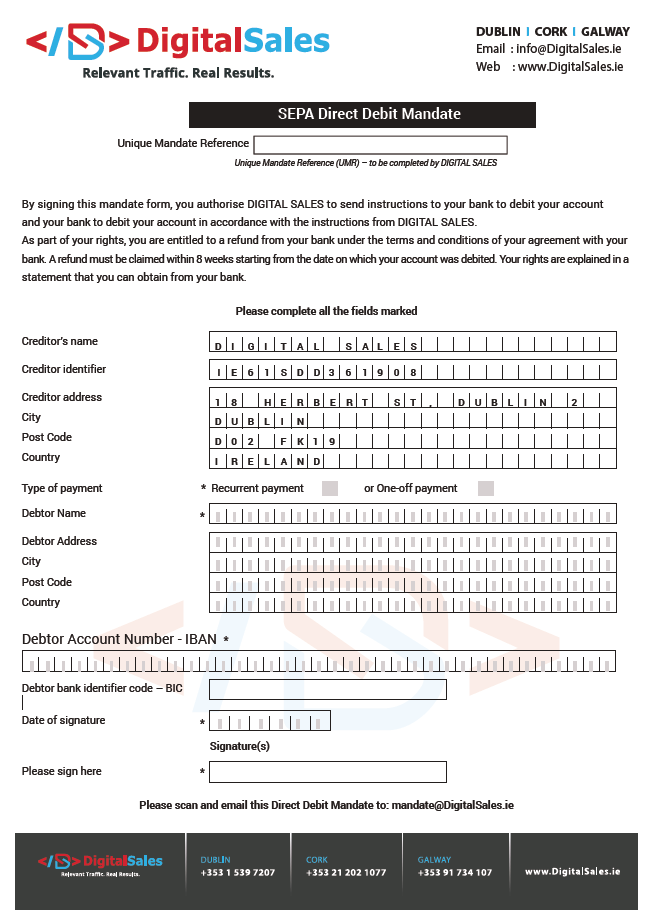
| Unique Mandate Reference (UMR) | Uniquely identifies the mandate |
| Payer’s name | Identifies the person or business authorising the debit |
| Payer’s IBAN | Identifies the authorised bank account |
| Creditor’s name | Identifies the business collecting the payment |
| Creditor Identifier | Identifies the creditor within the SEPA scheme |
| Address and location details | Meet applicable identification requirements |
| Payment type | Indicates whether authorisation is recurring or once-off |
| Date and signature | Record when authorisation was given |
The official documentation also specifies mandatory authorisation wording and information about the payer’s rights. Simply including the fields in the table does not replace the need for a mandate that complies with the official rules.
Some details, such as the BIC and certain address fields, are mandatory only under particular conditions. Businesses should check these conditions in the current rulebook and their bank’s guidance.
Why Is the Unique Mandate Reference Important?
The Unique Mandate Reference (UMR) is a reference that distinguishes one mandate from others held by the same creditor.
It helps link the authorisation to the collection instructions and the records used in the payment process.
If the reference is not available when the mandate is signed, SEPA Core rules allow it to be communicated to the payer before the first collection.
Keeping this information consistent across the mandate, customer records and payment files reduces the risk of discrepancies.
How to Obtain and Retain a SEPA Direct Debit Mandate
The business must provide the customer with a mandate containing the required information and declarations, obtain authorisation and keep records that can demonstrate that authorisation.
The process should be established before collections begin, taking account of the SEPA scheme being used and the terms agreed with the payment service provider.
Paper and Electronic Mandates
A mandate may be completed on paper or through electronic methods permitted under the applicable rules.
For paper mandates, the business must retain the signed document and ensure its details can be accessed when needed.
For electronic mandates, authorisation must follow procedures accepted by the parties involved. Businesses should not assume that any online form or tick box automatically constitutes a valid mandate.
The EPC also provides specific guidance on how mandates should be presented and how electronic solutions may be used.
Storing and Updating Mandate Records
Once authorisation has been obtained, the business should organise its records so they can be retrieved if a payment is disputed or the bank requests them.
Good practices include:
- Linking each mandate to the correct customer record.
- Retaining the reference, date and evidence of authorisation.
- Tracking changes to bank details and mandate information.
- Restricting access to personal and banking details.
- Retention periods and procedures should not be determined solely by administrative convenience. Businesses must take account of the SEPA scheme rules, banking agreements and relevant data protection legislation.
Retention periods and procedures should not be determined solely by administrative convenience. Businesses must take account of the rulebook, banking agreements and relevant data protection legislation.
SEPA Core vs SEPA B2B: What Changes for Mandates?
Both schemes require authorisation, but there are important differences in how mandates are handled.
Under SEPA B2B, the payer must be a business, and the payer’s bank must confirm the mandate details before processing the collection. This step is essential because the scheme does not provide the same refund right for authorised transactions.
| Criterion | SEPA Core | SEPA B2B |
| Who can pay | Consumers and businesses | Businesses |
| Mandate | Required | Required |
| Verification by the payer’s bank | No equivalent advance verification to B2B | Mandate details confirmed before collection |
| Refund of an authorised debit | Right to request a refund within eight weeks | Not provided for under the scheme |
These differences make it especially important to check whether the customer’s bank supports SEPA B2B and which procedures it uses to validate the mandate.
For the full rules, refer to the official SEPA Core and SEPA B2B documentation.
How to Use Mandate Details When Generating XML
Once authorisation has been obtained, the business must use the mandate information correctly when preparing direct debit collections.
For SEPA Direct Debit instructions, data is organised into XML messages based on the ISO 20022 standard, including the pain.008 message.
Details such as the mandate reference, the date it was signed, the Creditor Identifier and the payer’s IBAN must match the records held by the business.
The file also contains transaction-specific information, such as amounts, dates and collection identifiers.
It is important to distinguish between these steps: the mandate authorises the direct debit, while the XML file transmits the collection instructions. Neither, on its own, guarantees that the transaction will be accepted or settled.
How to Organise This Process in Your Business
A well-structured process starts with checking the customer’s details and ends with preparing the instructions for submission to the bank.
Dedicated XML file generation tools can help organise this stage and reduce the need to build the technical message structure manually.
However, generating the file does not remove the business’s responsibility to obtain and retain valid authorisations under the rules of the SEPA scheme being used. SEPA XML GENERATOR Product Tour
The responsibility to obtain and retain valid authorisations remains subject to the applicable rules and is not replaced by generating the file.
Frequently Asked Questions About SEPA Direct Debit Mandates
Can a SEPA Direct Debit Mandate Authorise Recurring Collections?
Yes. A mandate can authorise recurring collections or a once-off payment. The payment type must be correctly specified and must comply with the terms agreed with the payer.
Is an Electronic SEPA Direct Debit Mandate Valid?
It can be, provided the electronic process meets the scheme rules and the conditions applicable to the parties involved. Businesses should check the requirements for authentication, signatures and retaining supporting evidence.
What Happens When a Customer’s Bank Details Change?
The business must review the amendment procedures required by the scheme and the bank. Depending on the change, it may be necessary to update the mandate details and future collection instructions while maintaining a clear record of the authorisation.
Make Your SEPA Direct Debit Collections Easier to Manage
Collecting and retaining mandates correctly is an essential part of collecting payments through SEPA Direct Debit. With properly organised data, your business can prepare banking instructions more consistently.
Explore SEPA XML GENERATOR and discover how to simplify the creation of XML files for your payment operations.
A Sample sepa direct debit mandate you can find below from Digital Sales